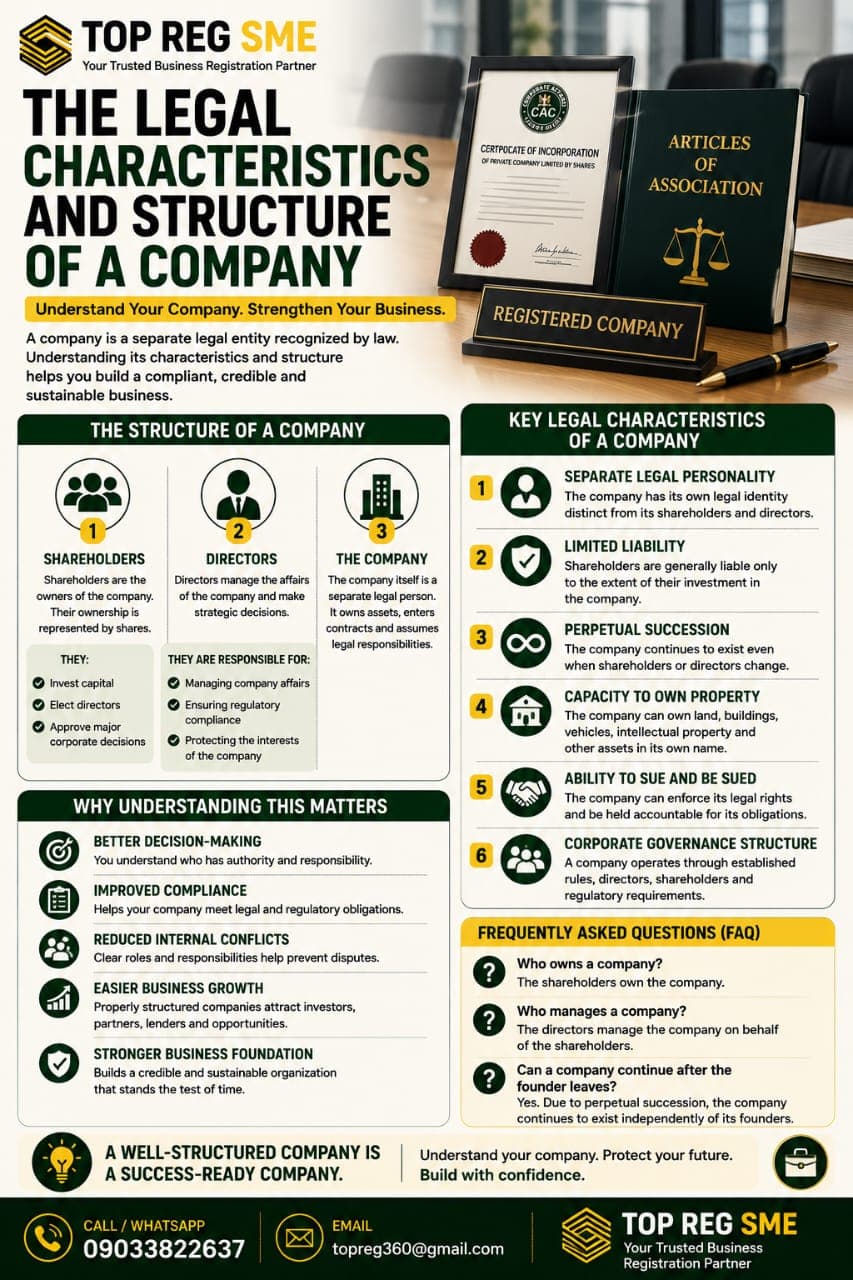
The Legal Characteristics and Structure of a Company
What Is a Company?
A company is an incorporated business entity recognized by law as having a legal personality separate from its owners.
Once registered with CAC, the company can operate independently of its shareholders and directors.
The Structure of a Company
1. Shareholders
Shareholders are the owners of the company.
Their ownership is represented by shares.
They are responsible for:
Investing capital
Electing directors
Approving major corporate decisions
2. Directors
Directors are responsible for managing the company.
They make strategic decisions and oversee daily operations.
Their duties include:
Managing company affairs
Ensuring regulatory compliance
Protecting the interests of the company
3. The Company
The company itself is a separate legal person.
It owns its assets, enters contracts, and assumes legal responsibilities independently of its owners.
Key Legal Characteristics of a Company
1. Separate Legal Personality
The company has its own legal identity distinct from its shareholders and directors.
2. Limited Liability
Shareholders are generally liable only to the extent of their investment in the company.
3. Perpetual Succession
The company continues to exist even when shareholders or directors change.
4. Capacity to Own Property
The company can own land, buildings, vehicles, intellectual property, and other assets in its own name.
5. Ability to Sue and Be Sued
The company can enforce its legal rights and be held accountable for its obligations.
6. Corporate Governance Structure
A company operates through established rules, directors, shareholders, and regulatory requirements.
Why Understanding Company Structure Matters
1. Better Decision-Making
Business owners understand who has authority and responsibility.
2. Improved Compliance
Understanding the structure helps companies meet legal obligations.
3. Reduced Internal Conflicts
Clear roles and responsibilities help prevent disputes.
4. Easier Business Growth
Properly structured companies are more attractive to investors, partners, and lenders.
Frequently Asked Questions (FAQ)
Who owns a company?
The shareholders own the company.
Who manages a company?
The directors manage the company on behalf of the shareholders.
Can a company continue after the founder leaves?
Yes. Due to perpetual succession, the company continues to exist independently of its founders.
Key Takeaway
A company is more than a registered business—it is a separate legal entity with a defined ownership and management structure.
Understanding these legal characteristics helps entrepreneurs build compliant, credible, and growth-oriented businesses.
At TOPREG SME, we help entrepreneurs understand, register, structure, and grow their businesses through professional corporate services